

AI and the Cognitive Ecosystems It Displaces
In my observations and experiences, much of the public conversation about AI and cognition is framed around the language of ‘tools’. A tool can be used well or poorly. A tool is only as effective as the user. A tool can be put down. Thus, the conversations end up asking these very limiting questions: should we use the tool, restrict the tool, or ban the tool?

Kudzu grows extremely well in any environment as the expense of plants that need more energy.
But AI does not act like a tool in any environment where it mediates cognitive work. I want you to think of it more like an invasive species. It’s an organism introduced into an ecosystem where it did not originally evolve, so efficient at performing the functions the native processes perform that it outcompetes them, not through malice intent but through better optimization. Kudzu does not hate the forest. It simply grows faster than everything around it and blocks the light the native species need.
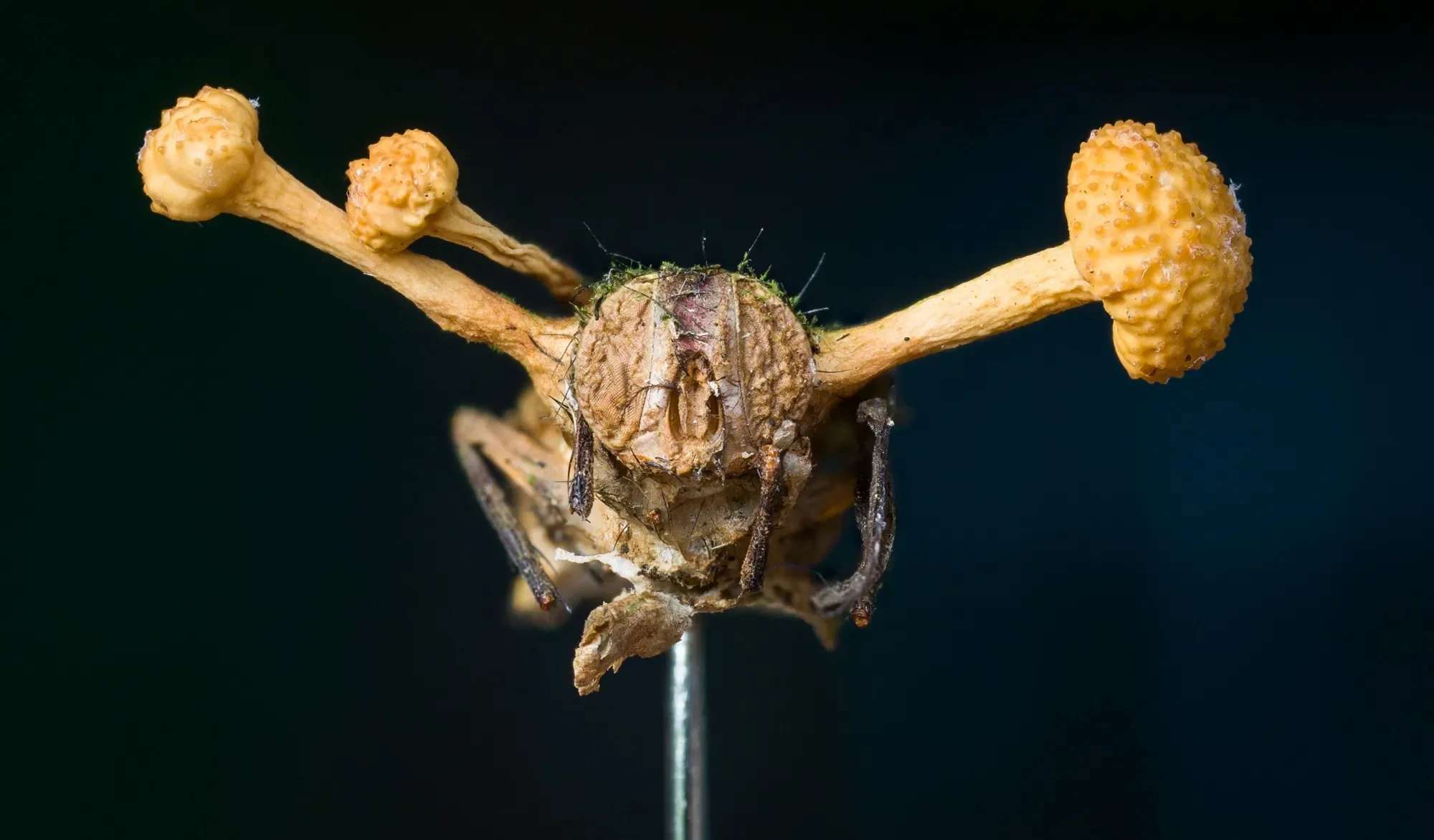
Cordycep fungus growing from a fly
Or have you ever heard of cordyceps. If Kudzu is the visible invasion, cordyceps are the invisible one. The parasitic fungus infiltrates an insect's body and takes over its motor functions. The host continues to move, to climb, to perform the behaviors it always performed. But the organism driving the behavior is no longer the host. The insect looks functional. It is no longer operating under its own direction. This is the closer analogy for what AI does inside cognitive work. The student continues to produce essays. The researcher continues to publish papers. The analyst continues to deliver assessments. The output looks functional. The question is whether the native cognitive process is still driving it or if its the fungal spores.
The distinction between a tool and an invasive species is the distinction between something that operates inside an ecosystem and something that restructures the ecosystem. A calculator operates inside a mathematical environment. The student still reads the problem, identifies the operation, interprets the result. AI restructures the cognitive environment it enters. It absorbs the reading, the identification, the interpretation, and the synthesis. The native cognitive processes that would have performed those functions do not coexist with AI but are displaced by it. Not because anyone intended the displacement, but because the organism is faster, more fluent, and more available than the native processes it replaces.
What is the Ecosystem?
Every cognitive ecosystem, whether a classroom, a law firm, an intelligence agency, or the citizens of a democracy, depends on a set of native processes that are slow, effortful, and durable. These processes are the substrate on which the ecosystem's functional capacity depends.
In a classroom, the native processes are struggle, confusion, productive failure, and the effortful construction of understanding from incomplete information. These processes build the neural architecture children will use for the rest of their lives. Developmental neuroscience has established that unused cognitive pathways are pruned (Casey et al., 2008; Steinberg, 2014). What is not practiced during the windows when the brain is calibrating its baseline architecture may not later form. I have argued elsewhere that this produces not atrophy, the weakening of an existing capacity, but foreclosure, the failure to build the capacity at all.
In a law firm, the native processes are adversarial reasoning, the construction and destruction of arguments, the exploration of hypotheses the attorney does not yet believe, and the slow development of case strategy through encounter with resistant material. When attorneys externalize these processes to AI systems, they expose the cognitive rough drafts that reveal more about their reasoning than any polished brief. Samsung discovered this dynamic in 2023 when engineers inadvertently transmitted proprietary source code and strategic deliberations to external AI servers through ordinary use of a chatbot. The exposure was not a breach. It was the technology functioning as designed.
In an intelligence context, the native process is the OODA loop (Observe, Orient, Decide, Act) operating through human analysts capable of questioning the framing of a problem, not merely optimizing within the frame provided. Gerlich (2025) found that heavy AI reliance produced measurable decline in critical thinking capacity. In a defense environment, the analyst who cannot synthesize independently cannot detect when AI-generated conclusions are compromised. The cognitive dependency does not create a new vulnerability. It removes the native capacity that would have detected the existing one.
In a democratic public, the native processes are disagreement, the tolerance of ambiguity, exposure to perspectives that do not confirm prior beliefs, and the slow formation of political judgment through encounter with genuinely different minds. Penney (2016, 2022) documented what happens when surveillance is layered on top of these processes: a 30% sustained decline in engagement with sensitive topics on Wikipedia following the Snowden revelations. People did not stop thinking but started conforming. The chilling effect does not eliminate thought. It replaces authentic exploration with the performance of compliance.
Each of these ecosystems evolved its cognitive capacity through friction. Each depends on native processes that are slower and less efficient than their AI substitutes. In each case, the introduction of AI at scale does not add a tool to the ecosystem. It displaces the native processes the ecosystem requires to function.
The Displacement Pattern
Invasive species ecology identifies a consistent pattern. The introduced organism does not typically kill the native species directly. It outcompetes them for the resources they depend on. The native species decline not through predation but through the loss of the conditions they require to sustain themselves. This pattern maps precisely onto what AI does inside cognitive ecosystems.
Doshi and Hauser (2024), publishing in Science Advances, found that generative AI enhanced individual creativity while reducing the collective diversity of creative output. The individual organism thrives. The ecosystem loses variance. This is the ecological signature of an invasive monoculture. Sourati, Ziabari, and Dehghani (2026), in Trends in Cognitive Sciences, documented that large language models push rare forms of expression and culture-specific reasoning to the margins and favor central tendencies in the training distribution. The ecosystem does not lose any single species. It loses the diversity that made the ecosystem resilient.
Travis Gilly (2025) working paper introduced the pediatric sentinel effect applied to algorithmic harm that adds a diagnostic dimension to the ecological frame. In environmental toxicology, children function as sentinel populations because their developing systems manifest exposure effects at lower thresholds and shorter latencies than adults. Gilly argues, with evidence across biometric surveillance, predictive systems, and recommender algorithms, that children play the same sentinel role for algorithmic harm. They show the ecosystem damage first. Not because they are weaker, but because the native processes being displaced are still forming in children while they are already established in adults. The seedlings fall before the old growth, but the old growth is not immune. It is simply slower to show the displacement.
What Invasive Species Ecology Teaches
The invasive species frame produces different governance conclusions than the tool frame. A tool can be used responsibly. You regulate the use. Ecological displacement of other species occurs regardless of the invader’s intent. You do not manage kudzu by teaching landowners to plant it wisely. You manage it by controlling where it is introduced, how fast it spreads, and what native ecosystems it is kept away from until the ecosystem is established enough to sustain itself alongside the kudzu.
The governance analogy is direct. An adult professional with decades of built cognitive architecture may coexist with AI the way established native forest coexists with a managed invasive species, not without cost, but without collapse. A child whose cognitive architecture is still forming, an institution whose analytical capacity has not yet been built without AI, or a democratic public that has not practiced disagreement under conditions of genuine uncertainty, may not. The ecosystem is too young or too fragile for an extremely efficient and new introduced organism.
Much of the governance conversation asks whether AI is a good tool or a bad tool. The better conversation is whether the cognitive ecosystems we depend on, for child development, for institutional judgment, for democratic self-governance, for the freedom of thought itself, can sustain the invasive species we have introduced into them at the current rate of spread. Containment must come before establishment. Protection of native processes before the introduced organism has displaced them. Assessment of ecological impact before deployment, not after.
The ecosystems are already under pressure. The native processes are already in decline. The children, as Gilly's sentinel framework predicts, are showing the damage first. Will the ecosystems AI enters survive what it displaces?
Timothy Cook is Director of The Cognitive Privacy Project and author of the "Algorithmic Mind" column at Psychology Today. He is Securiti Certified in AI Security & Governance.
Contact: timothy@cognitiveprivacyproject.org Web: cognitiveprivacyproject.org
© 2026 Timothy Cook / The Cognitive Privacy Project. All rights reserved.Licensed under CC BY-NC-ND 4.0. You may share this work with attribution. Commercial use and derivatives require written permission.



Hesitation before typing, deleted drafts, or pauses mid-thought are no longer private. They're data points. The Architecture of Total Capture introduces cognitive privacy and documents four convergent threats: pre-upload scanning, biometric sentiment tracking, analytic atrophy, and cognitive prompt injection.